Abstract
This field observation report examines how employee engagement and human capital utilization affect productivity in construction. Drawing on field observations and research on workforce planning, employee development, and performance management, it examines how limited growth opportunities, poor information sharing, and unclear expectations can reduce productive capacity. The report argues that organizations can improve productivity by developing employees, providing clear priorities, and increasing employee ownership of work.
Working Theory
Productivity is primarily driven by employee performance. While external factors like supply chain and technology can limit an organization’s production, those effects are more consistent across a sector while an organization’s employee utilization or human capital efficiency is more based in the company’s culture. I believe that a company’s productivity and employee efficiency is linked to the employee’s level of engagement.
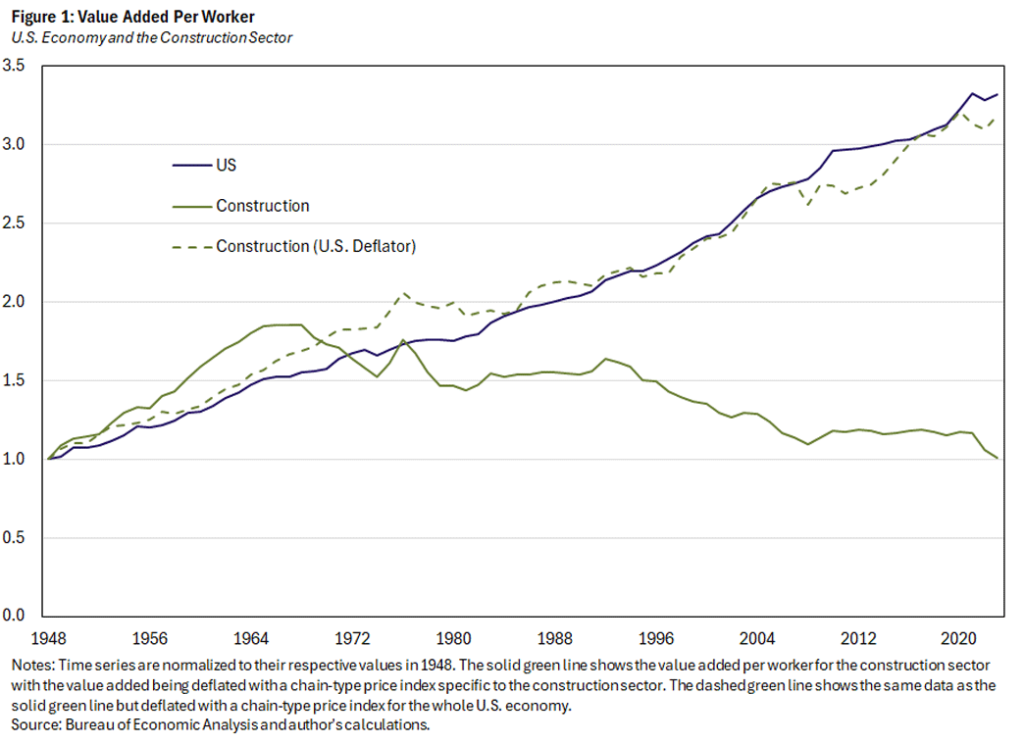
With labor productivity in the construction industry being on the decline since the 70s [1]. While recent data show some productivity improvements, studies acknowledge that subcontractor labor isn’t accounted for in the level of labor hours going towards the output [2]. My theory is the construction industry doesn’t prioritize employee development or their human capital utilization. This report will highlight my field experience with employee development and studies going over methods for human capital management.
Field Observations
Observation #1
Limited opportunities for growth and being pigeon holed into a process. This is something several Journeyman and apprentice electricians cite for moving companies. Either the management wasn’t promoting from within, lacked a development plan for employees or the business was comfortable with the role the electrician was performing, limiting their exposure to other aspects of the trade. The result was turnover due to lack of growth. The impact was the starting organization loses out on internal leadership and the individuals tasks specific knowledge. While there are performance gains in specialization, stagnation and limited learning seems to create complacency and hinder creativity.
Key Components of SHCM
Aligning HCM with Business Strategy.
Talent Management
Creating a Positive Organizational Culture
Better employee utilization could come from Strategic Human Capital Management (SHCM). This approach moves beyond hiring, training and performance measuring but aims to connect employee development to business strategy [3]. Something I observed through my organization was how they offer Survey and Leadership training to become more effective on jobsites, reducing errors and giving team members better communication and collaboration methods. SHCM also focuses on employee’s existing talents and finding ways the organization can leverage them for further growth.
Observation #2
Lack of visibility and information sharing is another area I observed leading to lower employee engagement. When information isn’t readily available (architectural design notes, reflective ceiling drawings, or approved change orders), or tasks aren’t prioritized (supports and labeling being required before conduit run is deemed finished) the job becomes less productive and employees don’t take ownership of the outcome. Delays and setbacks happen naturally; working around other trades, material constraints, RFI submissions but when employees are unable to pivot or are unaware of the next highest priority task production can stagnate. When information is readily available experienced electricians can find alternate wiring or layout methods that meet building requirements with the available material rather than simply wiring to the code book and missing project specific constraints.

A culture of continuous improvements relies on clear standards and measurable expectations. By translating a general instruction into measurable terms it creates accountability and clarity [4]. I’ve observed improved outcomes from my coworkers when I provide clear expectations of what needs to be done, for example pulling four cables into the electric room and supporting them afterwards. I also benefit from being laid out in such a manner by understanding why a task needs to be completed by a timeframe. With that information I can look for process improvements to meet that deadline. This also opens up the process for management to question or coach around metrics increasing employees ownership around a task [4]. By thinking about why a deadline wasn’t met or sharing the process on how the deadline was exceeded the employee is more engaged with the work.
Supporting Evidence
Evidence #1
Construction is an industry uniquely connected to their labor force since labor is the primary input of a construction business. The more employees they have the more they charge the owner or the general contractor as a subcontractor. Even with a labor markup the profit from labor is at risk due to inefficiency. [5] highlights the importance of effective workforce planning and how it helps contractors align workforce capacity with the project schedule. As a building is constructed the workforce demands shift from site preparation to foundations, to framing and rough into finishing and trim work.

With each stage requiring a different skill set proper planning can increase workforce effectiveness. Planning also requires a level of flexibility to manage changes or setbacks. This is why employee development is critical to overcoming lost capacity or scheduling constraints. With more employees trained on a particular process this simplifies organizations planning efforts and reduces keyman risk. If more staff members can work at several stages in a project it increases companies capacity to take on more projects or project variety. Workforce planning also highlights what skills are needed at a particular time and if efforts to use temporary labor or training is beneficial especially if the skill won’t be applicable to future projects.
Evidence #2
Planning highlights the various skills needed to accomplish a task but employee development is critical in making sure organizations have access to those skillsets. [6] cover the factors of employee development and the levers an organization can and can’t pull. The figure below highlights their Model of continuous employee development. The model highlights four factors; stable factors, malleable characteristics, previous appraisal and Organizational/ Economic environment.

Fig. 1. Model of continuous employee development.
This model highlights the feedback loop of employee development and how the organization plays a role in cultivating the circumstances to that development. While a company can’t alter the stage of career, age or even personal environment of an employee a company can focus efforts on other factors to increase engagement of learning and the improved efficiency it brings. By praising and promoting employees who engage in development it encourages others to follow a similar path and provides confidence that such a pursuit would be rewarded. The health and nature of the organization also shape how employees develop if there are multiple ways an employee can exist and contribute to a company. They may develop skills the company needs and they have a natural interest in.
Analysis
Analysis
Employee performance and efficiency is only one lever for an organization to pull to increase productivity. Other aspects were improved planning and employee development. In construction labor has an outsized impact on the productivity of a project and without clear priorities or not tying employees role to company objectives workers may disengage and not take ownership of the outcome. The field experience of employees resigning due to lack or opportunities for growth are shown to strike deeper at a company because they have limited workforce capacity and a loss of industry knowledge.
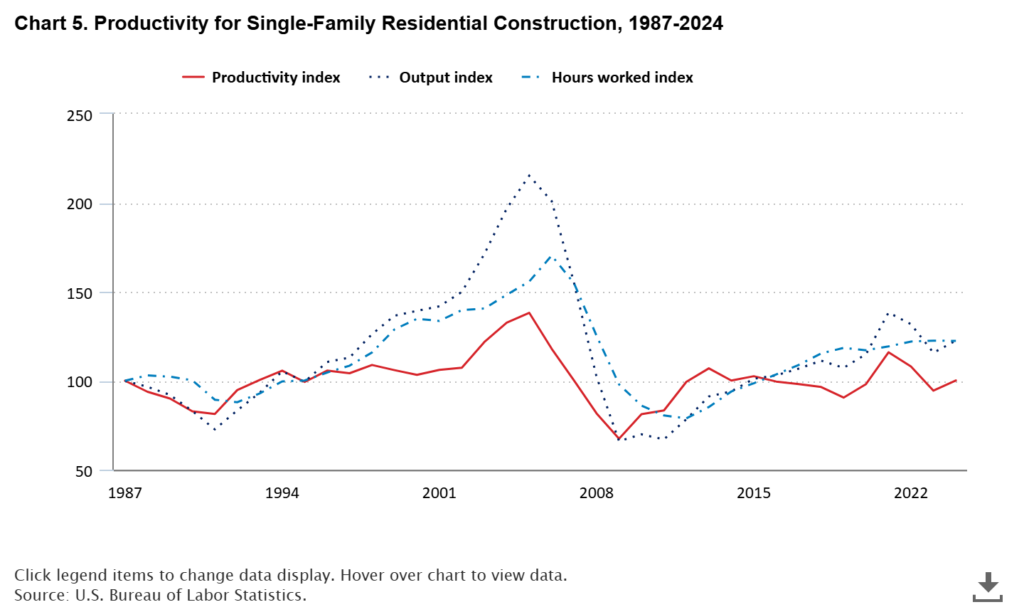
The decline of labor productivity in the construction industry may be a reflection of the larger economy and employer environment where career development and advancement isn’t visible or directly tied to employee learning reliant skills outside of current role. [6] points out factors that limit employee engagement with development which in turn limits the employers effectiveness at handling workforce constraints and overall job productivity [5]. I still stand behind the theory that improved utilization and development like SHCM [3] which connects employee development to corporate objectives would also improve productivity in construction. Higher levels of engagement through coaching over management and increased ownership [4] also drive high levels of productivity because less rework and documented obstacles.
Future Observational Questions
I question the impact that health and safety had on construction productivity. While my definition of productivity is more that just outputs over input and human health and safety must be taken into account I wonder if the report accounted for safety improvements in the construction industry limiting certain unsafe activities.
What is the impact of employee over education or over development that would lead to under utilization of the employee’s full capacity and result in resignations in pursuit of more challenging opportunities?
How best should subcontractor and temporary employees be calculated into their impact on productivity especially since projects and variable workforce demand.
Sources
[1] Five Decades of Decline: U.S. Construction Sector Productivity
https://www.richmondfed.org/publications/research/economic_brief/2025/eb_25-31
[2] Construction Labor Productivity
https://www.bls.gov/productivity/highlights/construction-labor-productivity.htm
[3] What Is Strategic Human Capital Management? Exploring the Power and Potential of SHCM
https://blog.utc.edu/business/2024/05/07/what-is-strategic-human-capital-management/
[4] Setting Clear Expectations: Improving Employee Performance in the Electrical Contracting Industry
[5] How Rising Material Costs Are Forcing Construction Firms to Rethink Workforce Budgets
[6] What influences continuous employee development decisions?
https://www.sciencedirect.com/science/article/pii/S1053482205000318#aep-section-id10